ABOUT
Sven Uwe Kaiser – Berlin Artist and Bon Vivant
The Berlin-based artist and bon vivant Sven Uwe Kaiser lives and works in the German capital. Born near the Polish border in the former GDR, he has been devoted to the creative act of art-making since his earliest years. A longtime figure in Berlin’s graffiti scene, traces of this artistic language can still be found in his work today. After years as a graphic designer and commissioned artist, he has been working independently and without constraints since 2016.
Kaiser draws inspiration from a hedonistic, positive, and philanthropic approach to life, as well as from the adventures and stories that unfold each day. A wild night at the bar, a journey into foreign cultures, or a leisurely walk through the forest or his local neighborhood—there are details to discover everywhere, and inspiration is always lurking. Constantly on the hunt for new impulses, Kaiser finds themes for aesthetic works, series, or exhibitions in almost everything—or sometimes simply an escape from everyday life.
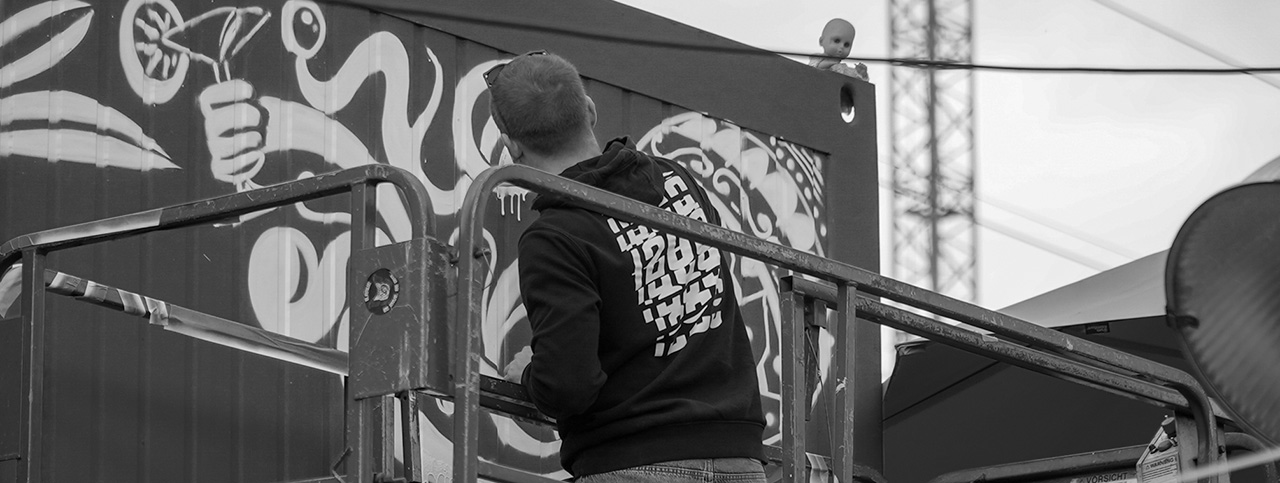
He is no fan of excessive chatter when it comes to visual art. He prefers to let his works and their titles tell their own stories and evoke unique emotions in every viewer..Yet, in these times of ominous change, politics has taken on an increasingly prominent role in his practice. His artistic output is diverse—ranging from canvas works to large-scale murals and sculptures to immersive installations—always embracing whatever the wellspring of ideas has to offer.
artist statement
I was born in the former GDR, in a country that no longer exists. Growing up after the fall of the Berlin Wall, I experienced a society in transition, where invisible borders continued to shape identities and perspectives. This awareness of division and transformation still informs my artistic practice. My work questions boundaries and creates spaces of connection.
My works appear like visitors from another world. They attract attention, arouse curiosity, and invite dialogue. They are not decorative surfaces or objects, but narrative spaces for encounter, reflection, and interpretation. Figures and objects have no fixed roles; they shift meanings and allow viewers to bring their own perspectives.
My practice is rooted in observation and lived experience. I travel extensively and immerse myself in the rhythm of the places where I work. Architecture and local stories flow into my visual language, resulting in site-sensitive works that remain recognizable as part of my artistic vocabulary.
The blue defining my work carries cultural history. Once an elite pigment, ultramarine became accessible through synthetic production. This democratization of color resonates in my work. Art in public space, for me, is a social practice that belongs to everyone and fosters dialogue, resonance, and shared cultural space.